
The bill
The forex bill is usually in the spread, not the advert
Updated . Redo the sums with your own ticket. This is a sketch.
A tight number on a banner is often the spread at three in the afternoon, on a quiet day, for a client the firm wants. Your ticket, at the moment you click, is the bill.
The spread is the cost of getting in
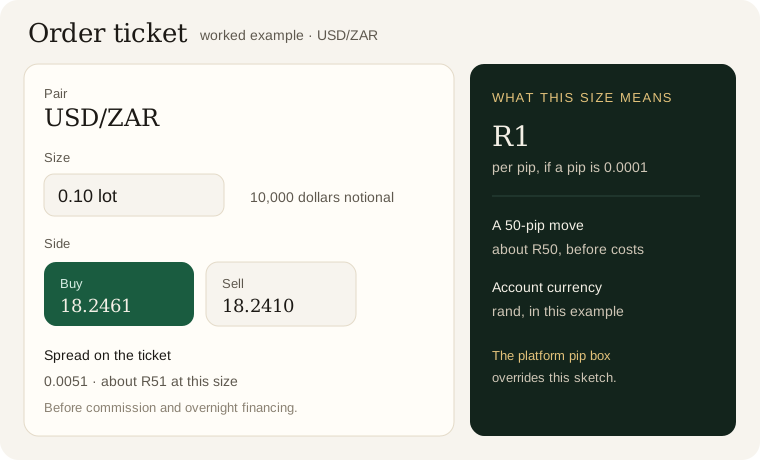
You buy at the higher price and sell at the lower one. On the sample ticket the buy is 18.2461 and the sell is 18.2410. The gap is 0.0051. If a pip is 0.0001, that gap is 51 pips. You pay it by starting the trade 51 pips behind, before the market has done anything you could call a view.
A worked example in rand
This only holds if the account currency is rand and the pair’s quote currency is rand. USD/ZAR qualifies. A pip of 0.0001 on 100,000 dollars (1.00 lot) is 100,000 × 0.0001 = R10. Scale it down and keep the zeros honest:
| Size | Dollars of notional | Rand per pip |
|---|---|---|
| 0.01 lot | 1,000 | R0.10 |
| 0.10 lot | 10,000 | R1 |
| 1.00 lot | 100,000 | R10 |
Spread on the sample ticket: 0.0051, which is 51 pips. At 0.10 lot that is about R51, before commission and before any overnight charge.
If the market then moves 30 pips in your favour, you are still behind. That is the whole lesson. A “small” position is not small if you measure it in notional. One full lot is a R10 move per pip. A hundred-pip afternoon, which is not a wild day on USD/ZAR, is about R1,000 on that lot, and a bad afternoon can be several times that.
If the account is in dollars, or the pair is EUR/USD, the platform converts. Read the pip box on that ticket. Do not reuse the rand table. The size guide starts from a rand amount you can lose, then asks whether the spread has already spent it.
Commission, when it appears as well
Some firms advertise a raw spread and then charge a commission per lot on top. Add it. A spread that looks like a gift, plus a commission, plus a conversion into rand, is often an ordinary spread wearing a nicer shirt. The cost disclosure is the page that should show all three. If it only shows one, ask for the others in writing.
Overnight financing
Hold past the firm’s roll time and you are charged, or sometimes credited, a swap. Long and short often pay different rates, and the rate changes. Many desks book three days of financing on a Wednesday to cover the weekend. That is a convention, not a statute. Your ticket’s swap figure is the one that will hit the account.
A trade that is “right” by twenty pips and held for two weeks can still lose money if the financing runs the other way. Write the daily swap down next to the spread before you decide the idea is cheap.
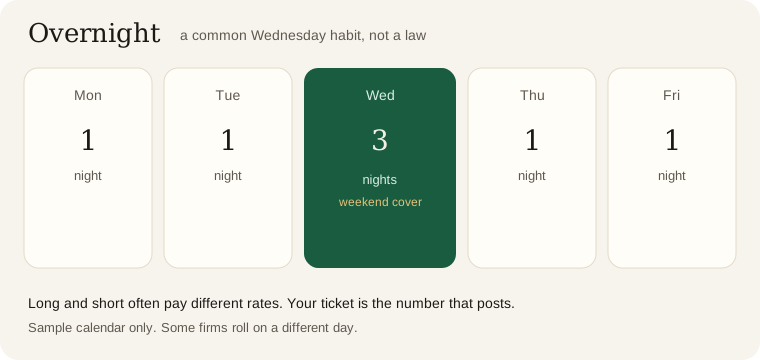
On the sample size of 0.10 lot, suppose the long USD/ZAR swap is about R2 a night and the short pays a different figure. Held from Monday to the next Monday, a Wednesday triple means you are not paying seven identical nights. You might be paying nine day-counts for seven calendar days, or the other way around if you are on the side that receives. The sign matters more than the folklore. A credit can flip to a charge when the rate changes, which it does, often without an email.
Two weeks of being right
Say the pair moves 40 pips in your favour and you hold it for ten weekdays. At R1 a pip that move is about R40. Ten nights at R2 is R20, and a triple Wednesday or two can eat the rest. You can finish flat, or down, on a trade whose chart looks successful. This is why the cost belongs in the note before the direction does.
The fees that never appear in the spread
- A card deposit that your bank treats as a cash advance.
- An international transfer, if you are sending money to a firm outside South Africa.
- A conversion, if the account itself is not in rand.
- Inactivity fees, which turn up in the client agreement long after the advert.
- Slippage: the fill you get when the price jumps between the tap and the confirmation. A demo that never slips will not prepare you for a rates decision.
Why the advertised spread is a photograph
USD/ZAR is wider than euro-dollar because fewer people quote it, and because the rand can reprice quickly on local news. A spread shown at 15:00 SAST on a dull Tuesday is not the spread at 01:00, and not the spread thirty seconds after a surprise announcement. If you want one habit worth keeping, it is this: read the spread on the ticket in rand, at the size you will really trade, before you care about the direction.